
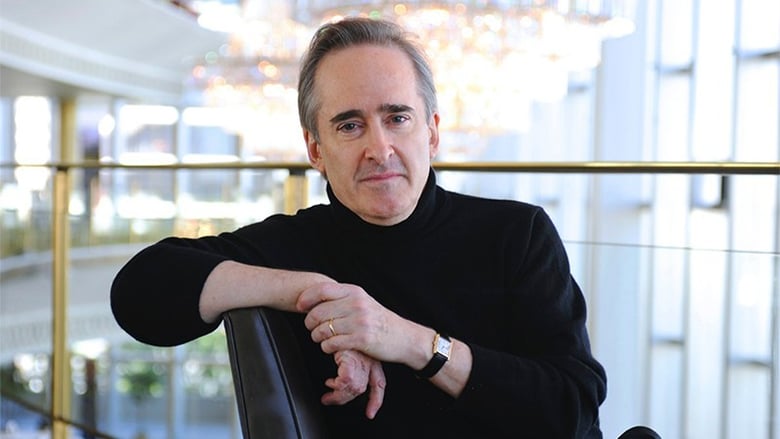
A Cosmic Scherzo: A Note from Music Director James Conlon
Verdi’s Falstaff and Mozart’s The Magic Flute, two great final operas from their respective and much-beloved composers, will be the last productions I will conduct as Music Director of LA Opera. I very much wished to mark this moment.
Verdi’s lifelong love for the works of William Shakespeare produced Macbeth (1847), Otello (1887), and Falstaff (1893). These three works have been with me since my earliest musical memories in the 1960s. I had seen two of them by the age of 14. Less than a decade later, in 1972, I conducted Falstaff, my first professional engagement. A year later, Macbeth, and by 1976, Otello. By the end of this series of performances, I will have conducted these three works almost in exact equal measure, 191 times.
Very early on, I became familiar with an essential literary voice when it came to both Shakespeare and Verdi. Through two essays, “The Prince’s Dog” and “The Joker in the Pack,” W.H. Auden opened a vast new horizon to me. The former, using Falstaff, and the latter, Iago, were starting points for a profound study not just of their authors, but of the universal implications of both characters—their worlds, and ours. There is a story, possibly apocryphal, that Auden, teaching a class on Shakespeare’s The Merry Wives of Windsor, opined that it was a boring and uninteresting play, and that its greatest significance was that it provided the world with a story that, centuries later, would inspire one of the great works of Western civilization: Falstaff, the opera.
It was written by a then 80-year-old Verdi, in collaboration with librettist Arrigo Boito. Together with their previous collaboration, Otello, Falstaff represents the zenith of Italian opera. It is a highly innovative culminating achievement of more than half a century of artistic output. Over those years, Verdi gradually transformed the meaning of Italian opera. He worked toward a continuous flow of music based on the dramatic situation. He gradually reduced the predominance of arias, cabalettas, set numbers, vocal display, and high notes. Falstaff and Otello perplexed some traditional opera lovers, but they also won over many with no particular sympathy for Italian opera—earning, in some cases, begrudging admiration. In the opinion of many, Falstaff’s musical and comedic perfection has never been matched.
It is a work of paradoxes, ironies, and contradictions. A raucous comedy with profound undertones, it reflects both the philosophical wisdom and resignation of old age. And yet it is infused with astonishing youthful vigor. It demonstrates a total mastery of marrying text and music. Dramatic wit, melodic and contrapuntal invention coexist in a musical text replete with self-deprecating humor and irony.
His three Shakespearean operas have encountered resistance and devaluation, as well as special reverberance, particularly in the Anglo-Saxon world. These works were constantly compared to their literary originals, disappointing some while convincing others. The majority view emerged that, in writing Macbeth, Verdi had made a giant leap in both his and contemporary opera’s development but fell short of Shakespeare’s masterpiece. Not so for Otello. Verdi and Boito, equaling Shakespeare, produced the perfect operatic equivalent of the original tragedy, leading the Italian operatic tradition to the first part of a double zenith. George Bernard Shaw, in his inimitable manner, observed: “The truth is that instead of Otello being an Italian opera written in the style of Shakespear [sic], Othello is a play written by Shakespear in the style of Italian opera....With such a libretto, Verdi was quite at home: his success with it proves not that he should occupy Shakespear's plane, but that Shakespear could on occasion occupy his."
And with Falstaff, they far surpassed the original Merry Wives of Windsor, considered one of Shakespeare’s weaker works. One of Verdi’s and Boito’s great accomplishments was to blend the Falstaff of The Merry Wives of Windsor with his original incarnation from Henry IV, Parts 1 and 2. Their rotund knight achieves a depth and breadth latent in Shakespeare but only realized in this musical reincarnation.
Falstaff has been with me for my entire lifetime of music making. I was in my early teens when I first saw it at the old Metropolitan Opera House in the now-legendary Zeffirelli/Bernstein production. Fewer than ten years later, I conducted it in my first professional engagement, literally a month after graduating from conservatory. Falstaff is to the conductor what Aida, Otello, and Rigoletto are to those who sing their title roles. Falstaff’s musical structure, the demands of a perfect ensemble of singers and orchestra, is now the “protagonist,” hence fully in the domain of musical direction. The challenge and joy of steering this ship, while the music goes by at the speed of light, is among the greatest experiences a conductor can have.
Fifty years separate this production of Falstaff—my eighth—from my first performance at age 22; approximately the same span separated Verdi’s first and final successes, Nabucco and Falstaff, and the failure of his first comedy Un Giorno di Regno and Falstaff’s rectification of that early misstep. There may be Verdi operas that I love as much, but none that I love more. He finishes his operatic life with a fugue—witty, ironic, and self-deprecating. Tutto nel mondo è burla… “Everything in the world is mockery.” I dedicate these performances to Giuseppe Verdi, with the gratitude that I—we all—owe him for what he has bequeathed to all of us, and to the entire world.
